
THE CHALLENGE
Aspen is a fast-growing native tree that would be abundant across Scotland without intense grazing pressure.
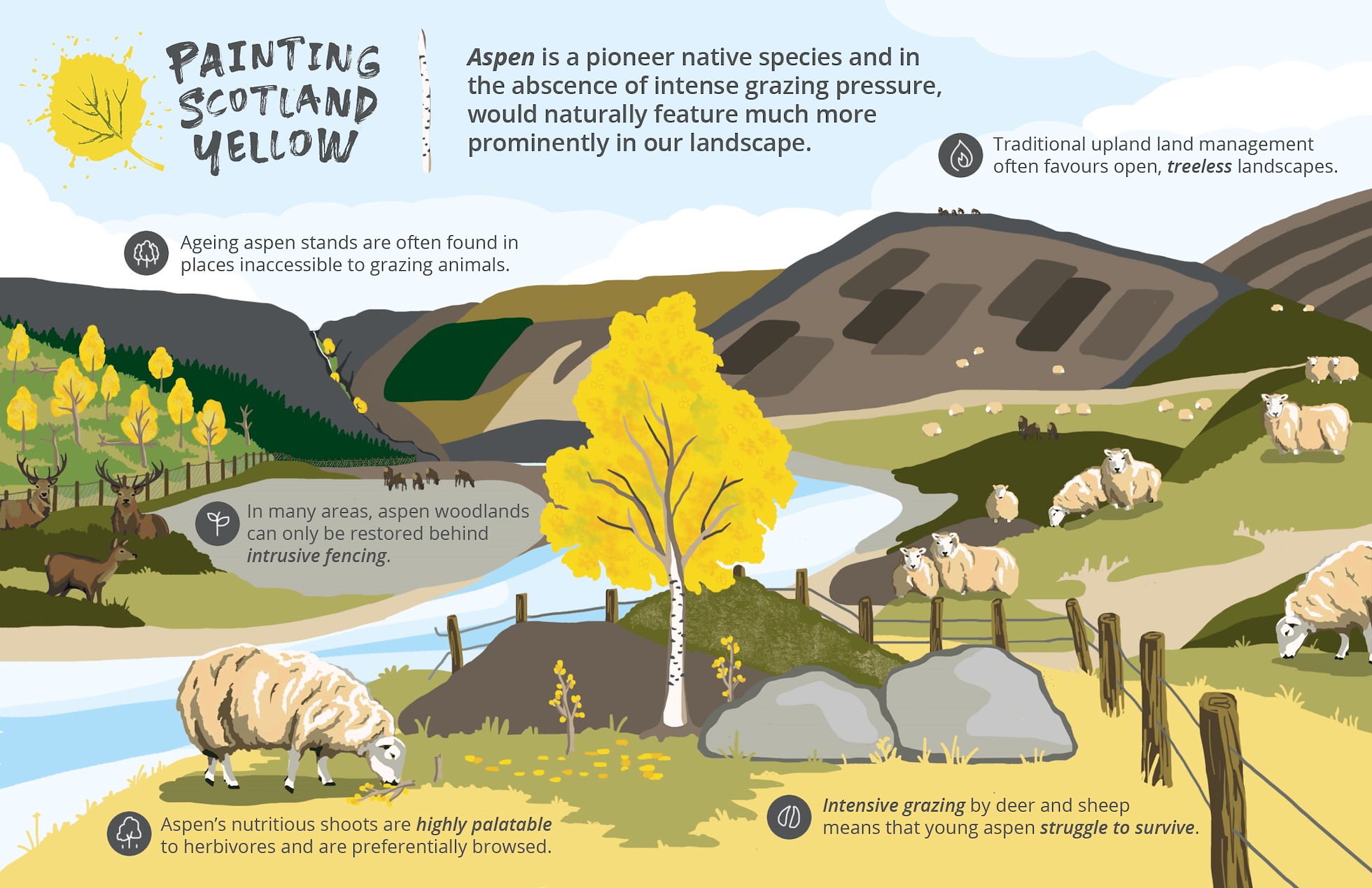
Considered a pioneer species, which typically grow fast and die young, their rapid growth efficiently locks away carbon, while their high rate of leaf fall and production of deadwood enriches the soil – creating the conditions for other plants and trees.
Aspen likely became established in the Scottish landscape, alongside trees like birch and hazel, after the ice retreated around 9,000 to 10,000 years ago, roughly 2,000 years before Scots pine. Today it can be found in a wide range of habitats, from riparian woodland to temperate rainforest, Caledonian pine forest to scrub and wood pasture.
However, the palatability of aspen to deer and livestock means the species is now scarce in Scotland and most often found in places inaccessible to browsing animals. Given the chance to flourish, aspen can quickly form large stands in almost any soil and setting.
Aspen fact:
When aspen produces seed, a single catkin can hold 1,000 to 2,000 seeds and a single tree can hold 40,000 catkins. That’s potentially 40 million to 80 million seeds per tree!
Getting aspen back into our woodlands isn’t easy. Natural regeneration and expansion from existing stands would be preferable, but this relies on reducing the impact of high deer numbers, which in many places is economically and culturally sensitive. In the meantime, fencing is an option but this too is challenging, with many aspen stands fragmented and consisting of only a small number of trees, in addition to the visually intrusive nature of high fences.
Aspen is now being planted as part of a drive to restore native woodlands, but the availability of saplings is a limiting factor. Unlike most trees, aspen rarely sets seed in Scotland and instead relies on the root system of one tree sending up ‘suckers’ to create clones of itself. As a result, most aspen growers take cuttings from these roots and grow them on – a labour intensive job – or they wait for one of the few years in which aspen flowers in order to collect seed.
It’s easy to see why restoring aspen to our diminished native woodlands is less than straightforward.