
Wildfire: beyond the blame game
Following his experience fighting the devastating wildfires that have ravaged part of the Cairngorms National Park, rewilding advocate Hugh Webster discusses how we might reconcile nature restoration with the growing risk of wildfires, urging a joined up approach that combines knowledge, experience and every available tool.

The Glenmore-Strathnethy fire has devastated wildlife habitats and stretched SFRS resources. Hundreds of firefighters – including volunteers like me – travelled long distances to tackle the fire alongside RSPB staff, local residents, gamekeepers, neighbouring estate workers and many others. But could this costly disaster have been prevented?
Some have blamed the RSPB (who own the land where the fire started). Others have pointed the finger at rewilding organisations and even the Scottish Government. The key accusation is that deer numbers have been excessively reduced while muirburn (the controlled burning of vegetation to create conditions favourable for livestock or game species) has been neglected. As traditionally managed moorland has begun to transition to a more natural mosaic of woodland, bog and everything in between, critics argue that the accompanying flush of vegetation growth has created a dangerous fuel load.
This narrative overlooks the fact that a history of muirburn and grazing didn’t prevent the Dava Moor fire in 2025. Before the Dava Moor fire – still Scotland’s largest by area – a much-cited study published in 2024 detailed the hitherto limited spatial overlap between wildfires and areas subjected to muirburn. Many have used this study to argue that muirburn prevents wildfires, but the study’s authors were more nuanced.
They noted that aside from lower fuel loads ‘there may be other reasons that moorlands under muirburn management have fewer wildfires.’ Crucially, they noted that ‘burnt moorland landscapes are less desirable destinations for recreational activities than non-burnt ones and have a lower risk of wildfires caused by disposable barbecues and campfires.’

Reduced grazing pressure and freedom from muirburn allows vegetation to flourish, creating rich wildlife habitats – but also more potential fuel for fires.
Clearly then, while there is a kernel of truth in the fuel-load narrative, the full picture is, as ever, more complicated. Environmental organisations certainly have been working to reduce deer numbers, aiming to expand surviving pockets of native woodland, boost biodiversity and restore degraded peatlands. But they have also reintroduced large herbivores to many sites, including those breeds of native cattle and ponies that best replicate the influence of lost species.
Crucially, diverse native woodlands don’t reappear overnight. Once browsing pressure is reduced, a shrubby stage precedes trees becoming established, often incorporating relatively flammable species like gorse, broom or juniper with great value for wildlife. Eventually, broadleaf trees like oak, ash, birch and rowan, create more fire-resistant habitats, but as recent fires have shown, coniferous woodlands – even mature pinewoods – remain vulnerable.
Still, if a natural build-up of vegetation can increase the availability of potential fuel, it hardly follows that we should abandon habitat restoration efforts. Similarly, furniture and belongings increase the fuel load in your house. But just as furniture and furnishings turn a house into a home, vegetation growth creates complex three dimensional habitats that turn raw physical geography into rich living systems.
The notion we should regularly burn or graze all of Scotland down to ankle height just to reduce the risk of uncontrollable wildfires is therefore plainly absurd and fundamentally incompatible with nature recovery. Muirburn kills young trees – including threatened species like whortle-leaf willow and woolly willow – and eliminates fire-sensitive shrubs like juniper, a ‘Biodiversity Action Plan’ priority species. Without trees, you can’t sustain rare woodland wildlife like capercaillie, red squirrels, Scottish crossbills or pine hoverflies.
Nonetheless, woodland expansion remains unwelcome for some. In a break from tackling the fires, I met a farmer at Nethy Bridge who told me, ‘Rewilding has gone too far. We can’t have trees everywhere.’ In reality, the Cairngorms National Park still only enjoys around 17% woodland cover, while Scotland as a whole boasts levels of woodland cover far below the European average. By contrast, up to 40% of the Cairngorms continues to be subjected to muirburn.
But if rewilding ambitions are entirely defensible, could landowners of all sorts be better prepared for wildfires? Above all, do we need more firebreaks? These could limit fire spread through recovering habitats, similar to how compartmentation works to limit fire spread in buildings. Natural firebreaks, provided by rivers or wetlands, already do this job, so we need to redouble existing rewetting efforts, but natural firebreaks will never extend everywhere, meaning artificial firebreaks may be needed. These can be ugly and expensive, but there are ways to reduce the cost.
One option might be to use cattle with ‘fenceless’ collars to graze firebreaks. Alternatively, we could plant more fire-resistant deciduous trees in strips through fire-prone habitats. Everything has to be on the table, including muirburn – not as a landscape scale tool of woodland suppression, but as a practical tool for creating and maintaining linear firebreaks where appropriate.
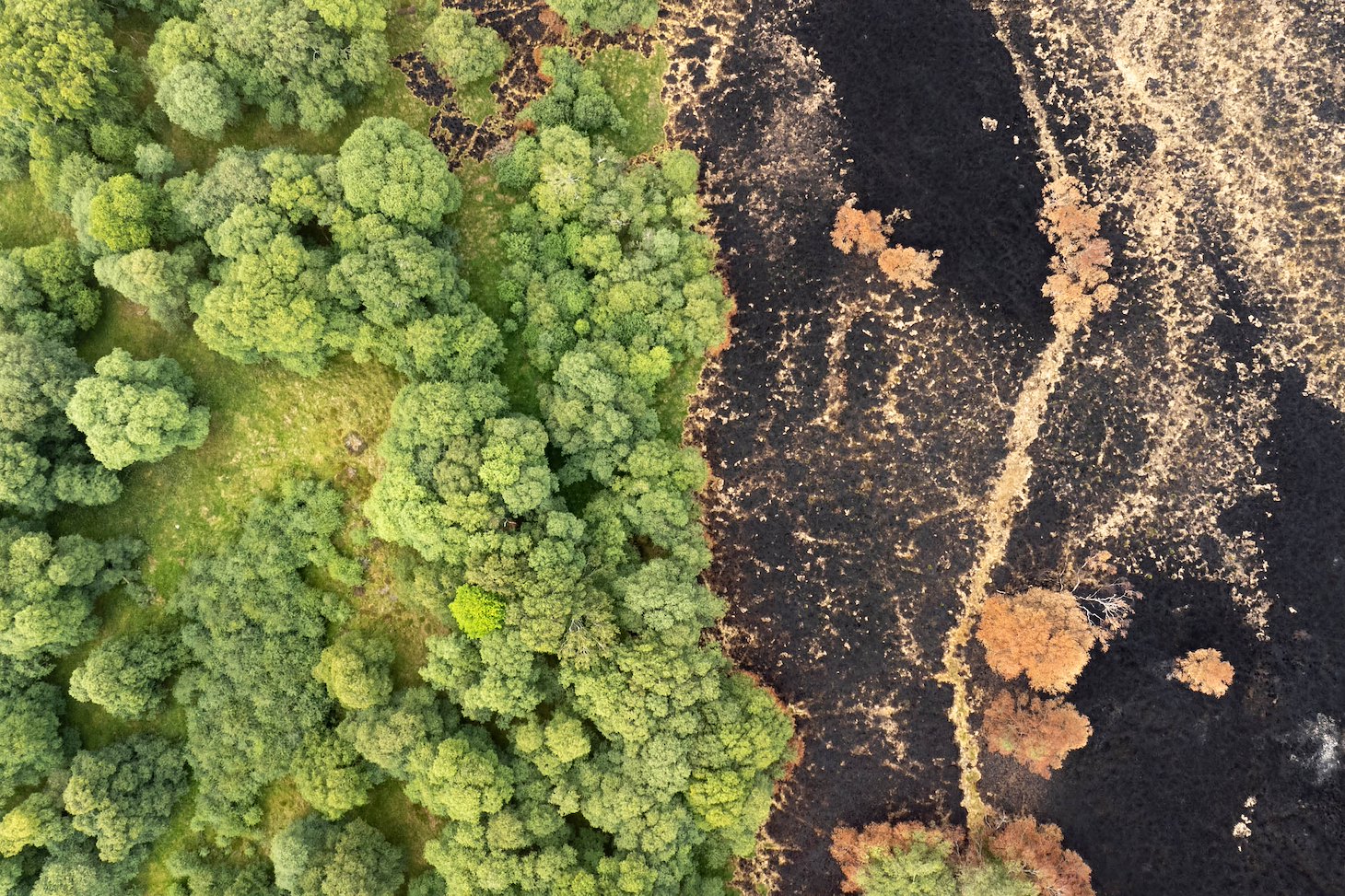
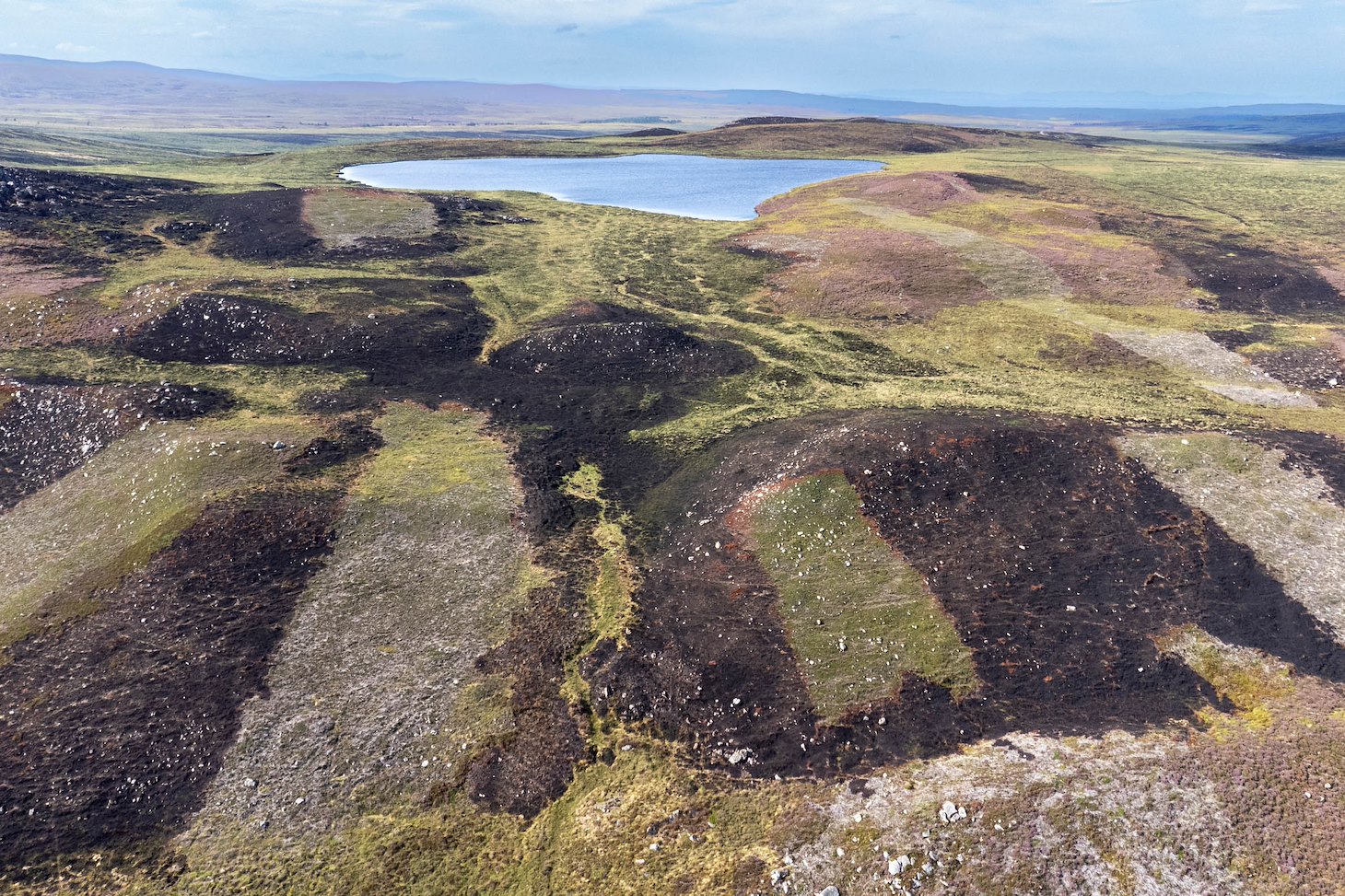
[Left] The shade, cooler temperatures and higher moisture content found within established deciduous woodlands make them relatively fire resistant. [Right] Natural bogs and artificial muirburn patches both reduce fire spread, but the best firebreaks are contiguous with fire resistant landscape features, reducing the risk of being bypassed.
We also need to increase public awareness about wildfire risk alongside stronger legal deterrents. 95% of wildfires in Europe are started by humans and since rewilded landscapes attract more people, this increases the risk of fires. Is a small fine – up to £500 in the Cairngorms – enough of a deterrent against lighting fires when sheep worrying can attract a £40,000 fine? How strictly are current fines enforced? How long will disposable barbecues remain legal?
Lastly, we need to reconsider how we respond to wildfires. In the fallout from the Glenmore-Strathnethy fire, questions have been asked about the official response. Do we have enough readily available personnel with the right training and the right equipment to tackle wildfires before they get out of control, especially when such fires often start in remote locations? Does the UK need its own aircraft with the capacity to drop really large volumes of water?
Climate change is the common enemy here. The debate shouldn’t be about one philosophy of land management versus another but about how we adapt to a growing threat. Everyone has something to contribute, and we’ll reduce wildfire risk far more effectively by combining knowledge, experience and every available tool rather than by indulging in finger-pointing and tribalism.
That’s why we’re calling on the Scottish Government to commence an urgent review, involving all stakeholders, to assess our readiness to combat wildfires. It’s time we treated wildfire as the emerging national crisis it really is. If we don’t prepare better for the next one, the consequences could be even worse.